

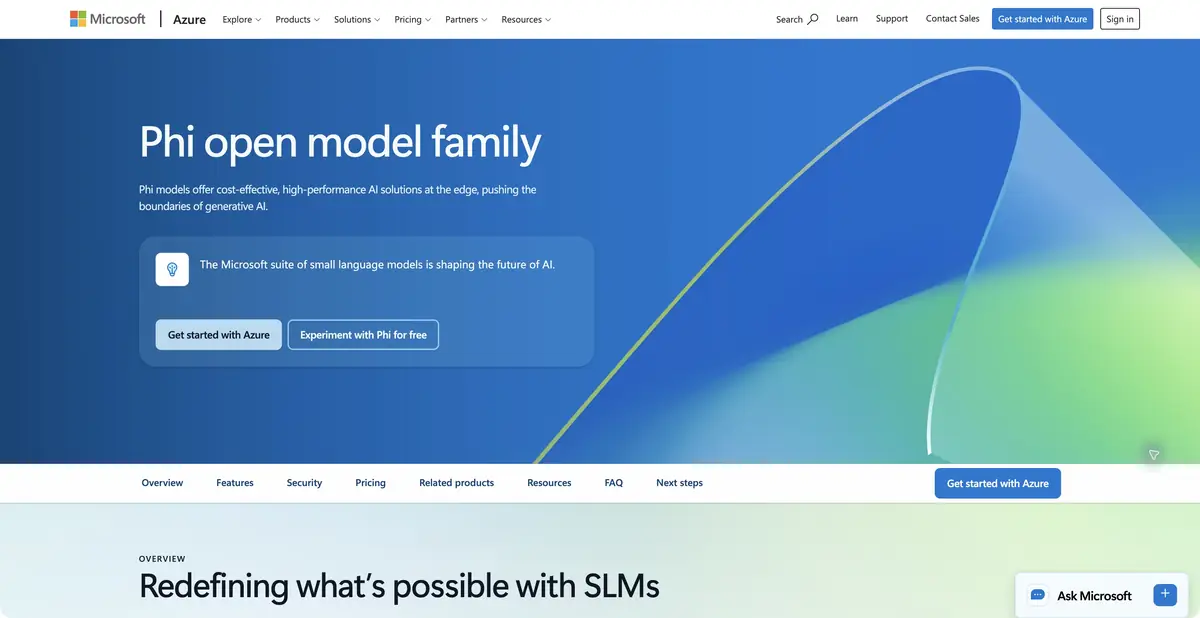
Phi is Microsoft's family of compact models for developers. They provide the basis for custom AI features; a suitable variant can run locally or through cloud infrastructure.
An AI feature inside your own application
Phi can power a small assistant that analyzes supplied text, explains a code snippet or works in a chosen computing environment. Microsoft publishes a family of models with different capabilities. The team selects the weights, deployment method and interface through which people submit requests.
Model weights and the application used to interact with them serve different purposes. Phi determines generation behavior, while the runtime handles loading, requests and deployment. A model appearing in the Ollama catalog therefore does not make it a separate version of Ollama: they are compatible parts of the same system.
Choose modalities first
The family includes text, reasoning and multimodal variants. Check the specific model card for image or audio input support. For example, Microsoft describes Phi-4-reasoning-vision-15B as accepting text and images and producing text. Do not assume that it has the capabilities of another configuration.
For a photograph of a document, decide in advance what you need: a recognized passage, an answer to a question or an explanation of a table. Small print, cropped edges and illegible digits can distort the answer. Keep the original image for comparison.
Example: questions about a short set of instructions
Take an anonymized product return policy and ask for three questions to check understanding. Include a supporting sentence from the source with each answer. If the return period is not stated, the model should flag the gap rather than fill it using familiar rules from other shops. Check the quotations and repeat the exercise after removing one important sentence. This is an editorial learning example, not the result of a Phi test we conducted.
What you need for your own deployment
Phi Cookbook provides instructions for different environments, including local servers, ONNX Runtime and Apple MLX. Compatibility depends on the selected weights and format. Before downloading, check the supported hardware, software dependencies and requirements of the specific guide.
Weight file size alone does not show total memory use. Input length, numerical format and simultaneous requests also affect it. For a working application, measure latency and memory consumption on your own device; the family's compact size does not guarantee the same speed on every laptop.
Licensing and cloud costs
The official Phi pages and the model card reviewed specify the MIT license. Before distributing your own solution, retain the required notices and read the terms of the particular release.
Open weights are available for independent use, but hardware and maintenance remain project expenses. Microsoft also describes inference API access with usage-based billing. Check the model selection, quotas and availability of cloud deployments separately. A model's documentation does not replace the terms of the cloud service you connect to.
Suitable tasks
- Create verifiable questions about a short set of instructions
- Build text or code processing into your own application
- Analyze a document image with a suitable multimodal model
- Compare local configurations against device constraints
Strengths
- Official weights, model cards and examples from Microsoft
- Local and cloud deployment options
- Variants for text, code and multimodal tasks
Limitations
- Modalities and language capabilities vary between models
- Your application needs a runtime and answer verification
- A compact model still needs suitable memory and hardware
Selection and conditions
- Free access
- Yes
- Trial period
- Not confirmed
- No sign-up required
- Not confirmed
- Russian interface
- Not confirmed
- Local installation
- Yes
- API
- Yes
“Not confirmed” means there is not enough information. The feature may still be available; check the developer’s terms.
- Input formats
- Text, Code, Image, Audio
- Result
- Text, Code
Terms
The free option refers to the open weights under MIT in the model card reviewed; hardware and cloud API use have separate costs. Check local deployment, input modalities and language capabilities for the selected model and environment.From task to first result
Practical example
- Task
- Create verifiable questions about a short set of instructions
- What to prepare
- Short instructions for returning the goods, saved in plain text.
Task brief or prompt
Based on this guide, write three questions to test understanding. For each, provide the correct answer and a supporting sentence from the input. If a deadline or condition is missing, say so explicitly.
Expected result
Three question-and-answer pairs, based on the submitted text.
How to check the result
- Compare each answer with the initial sentence.
- Repeat the task with the selected local model and evaluate the time and memory consumption on your device.
An editorial teaching example of a task brief, not the result of hands-on testing of the service. Check that the required mode is available, that you have rights to the source material and that the intended use of the result is permitted.
Check details
Official sources
- The Microsoft Phi open model family
- Official Phi Cookbook: deployment, configuration and examples
- The Phi family and differences in modalities
- A guide to running Phi on a local server
- Microsoft Phi-4-reasoning-vision-15B model card and license
This description is based on the developer’s material. Features, prices and availability may change; check the primary source before use.