
A practical guide
NotebookLM: finding contradictions in sources and verifying quotations
One document promises to process a request in two days; another promises a response within two working days. Here is how to compare those statements in NotebookLM and determine whether they genuinely conflict or simply lack definitions.

Two similar promises can mean different things.
“We process a request in two days” looks similar to “a response to the client within two working days”. Processing may finish before the response, however, and calendar days differ from working days. Asking AI to merge both into one rule immediately can erase that distinction.
For this teaching example, call the first text “Memo A” and the second “Regulation B”. Our task is to identify discrepancies and prepare questions for the process owner. There is not yet a basis for claiming that one document automatically overrides the other.
Google’s current help calls the service familiar as NotebookLM “Gemini Notebook”. This article focuses on selected sources and verifiable quotations; individual controls may be positioned differently on a phone than in the browser version.
Prepare a small set of sources
Create a separate notebook for the deadline question. Add the memo and regulation with distinct names, and keep originals alongside the working material. If several versions exist, include the version in the title: “Regulation B, version 3”. Open the uploaded material and check that the relevant phrases are readable. Inspect tables and notes carefully: a deadline may concern only one request type. Before comparing, select exactly those two documents in the sources panel. Exclude other material from the answer for now.
A file name helps distinguish versions, but does not confirm which version is in effect.
First, analyze each statement separately
Ask the memo a short question: “What time limit is stated for processing a request? Quote it exactly and identify the event that starts the clock. If no starting point is defined, say so.” Repeat the check for the regulation. This reveals whether the answer has invented a missing condition.
Suppose a memo does not explain which days count. Record “not specified”. Assuming calendar days merely because “working” is absent is premature. Apply the same care to “process”, “accept” and “respond”: they may refer to different stages.
Ask for a table of discrepancies with the evidence
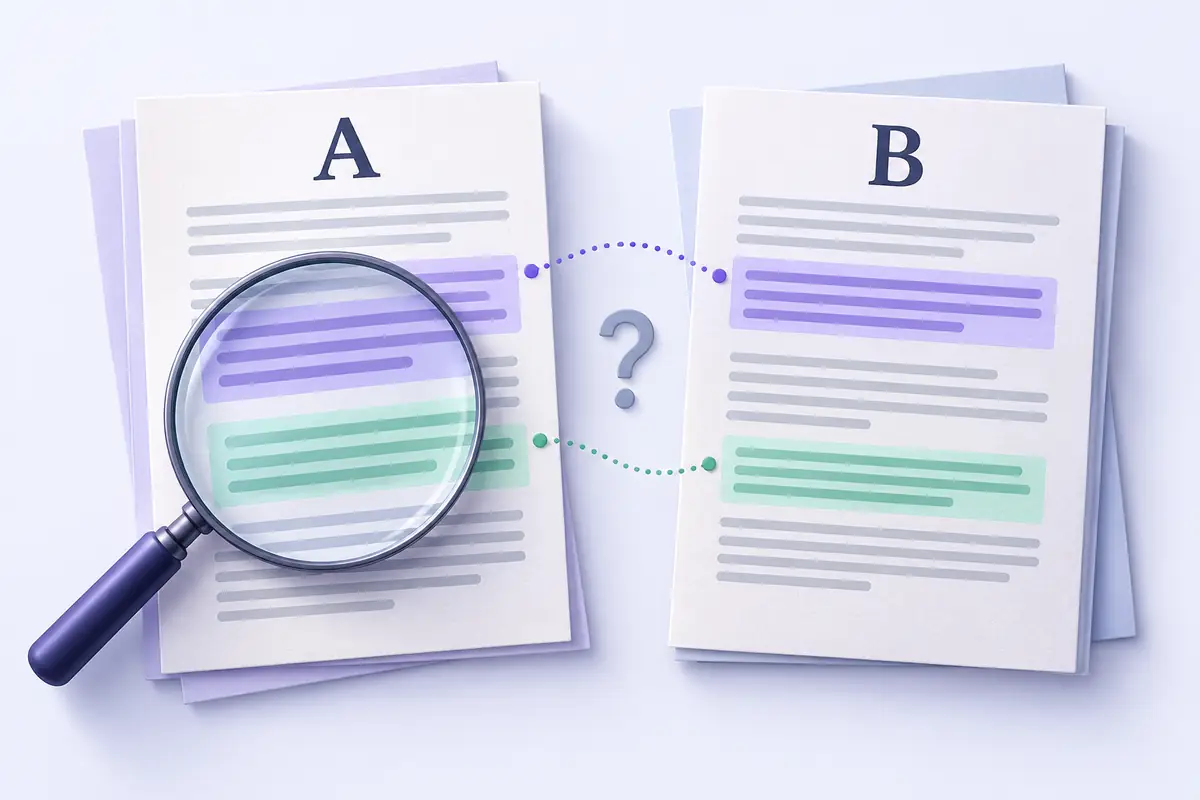
Select both sources and send this prompt: “Compare the deadline rules in Memo A and Regulation B. For each item, identify the source, exact wording, action, starting point and time unit. Distinguish an explicit contradiction from a difference in detail. Support every observation with a quotation. Do not decide which document takes precedence unless the sources themselves establish that.”
The table should produce a list of verifiable differences. Our example has two events and an undefined method of counting days in the memo. If both documents set different deadlines for the same action under identical conditions, there is then a basis for discussing a contradiction.
Open the quotation and read the surrounding paragraphs
Clicking a citation in an answer opens the relevant source passage. Check whether it supports the entire conclusion. A statement about two working days may appear under “Corporate requests” while your question concerned retail customers. An exact quotation alone does not make a comparison correct.
Read the condition before a quoted sentence and exceptions after it. For a short document, the service may cite the entire source, leaving you to locate the passage. In your report, retain the document title, section and checked passage. This lets you retrace the verification without chat history.
Finish the check with a question you can resolve
The final note might read: “Memo A sets a time limit for processing a request, while Regulation B concerns responding to a client. The memo does not define the type of days or the starting point. We need confirmation that the rules concern the same stage and which version is approved.” This is more useful than a confident but unsupported claim that an error exists.
When the process owner clears up the rule, keep his or her answer as a separate document with clear origins. Then repeat the comparison with the updated set of sources. NotebookLM helps to find and link evidence; the decision on which rule is valid should be based on the authority and content of the documents.
