
A practical guide
Midjourney Style Reference: an illustration series in a consistent style
A house, plants and a sailing boat can look like parts of one project. That requires a clear visual principle, a reference image and checks to keep the series from drifting apart after a successful first image.
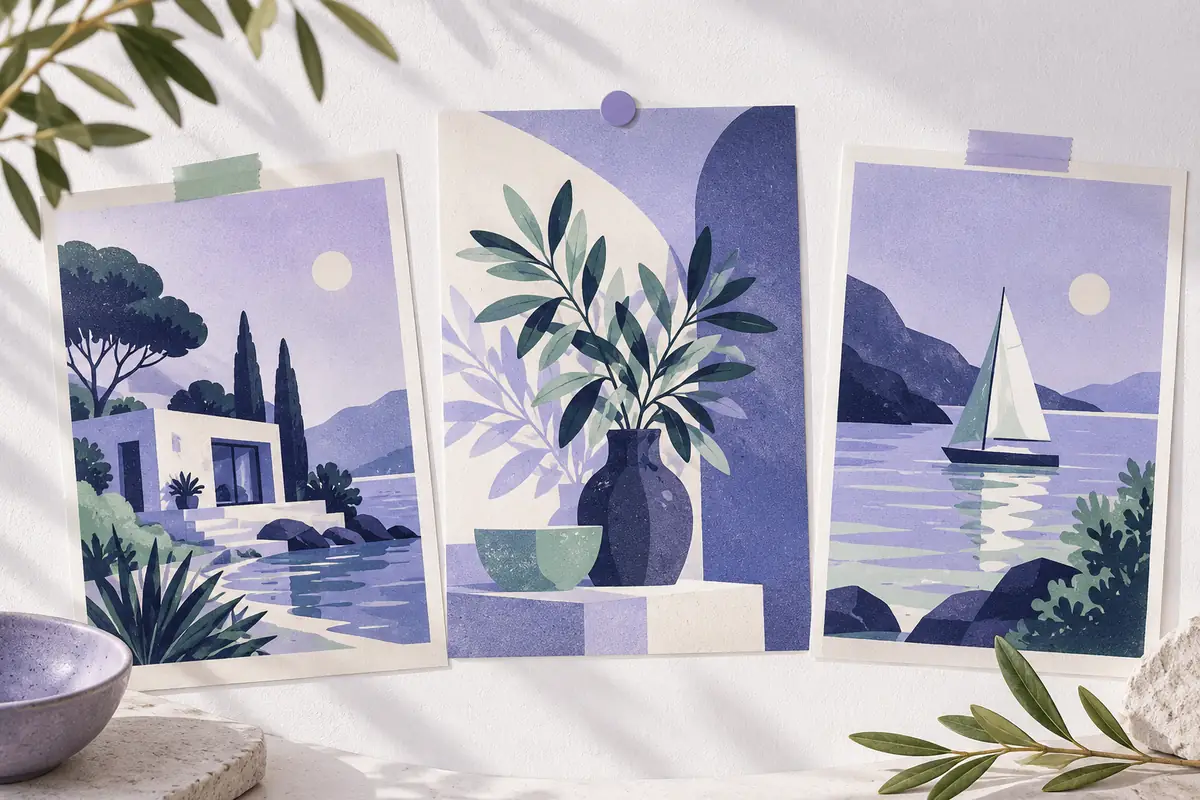
Give the series a few consistent characteristics
Three attractive images do not automatically form a series. The house uses flat blocks of colour, the plants look like a studio photograph and the sailing boat suddenly appears in watercolour. Each can be kept separately; side by side, they clash.
Start with a short creative brief. Our example uses three posters: a small house, leaves and a sailing boat. Shared features are lavender, deep indigo and muted mint, a paper texture, large geometric silhouettes and a subdued background. This is specific enough to compare results while allowing different subjects.
Record the format and intended placement too. Square card covers and wide in-article illustrations need different compositions. If the layout is known, define a safe subject area and room for text before generation. This reduces the risk of producing an attractive image that later needs an awkward crop.
Choose a reference that clearly conveys the aesthetic you need
Style Reference in Midjourney transfers visual properties from a reference image: colour, material, texture, lighting and overall impression. Copying a particular object or person is a separate task. For this series, a shared way of depicting different things is enough.
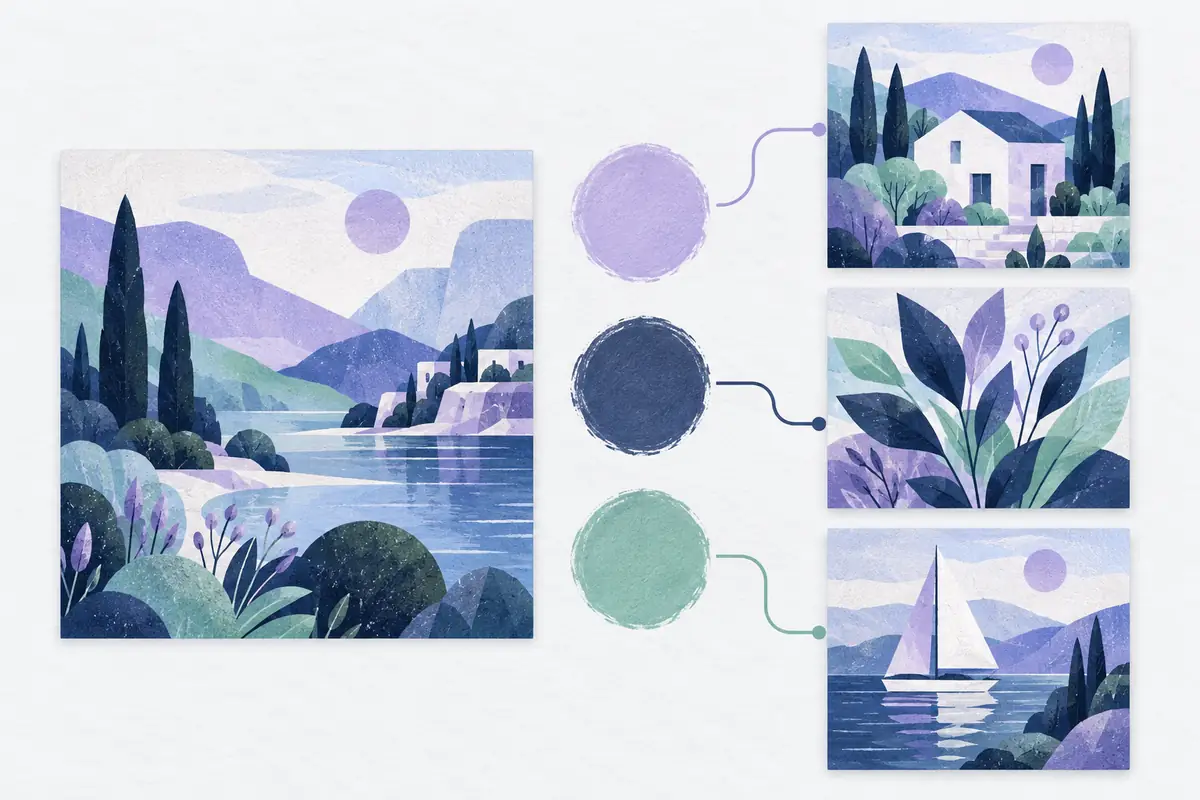
Choose one work with clearly visible features. A reference sheet containing around ten posters mixes small details, typography, borders and different lighting. A simple plant illustration on textured paper provides a clearer starting point: you can identify the main colours and the required coarseness of the grain.
Break a reference into four aspects: palette, silhouette edges, surface and detail density. It might use sharp geometric outlines, light grain, three subdued colours and plenty of empty space. If its appeal rests only on a beautiful face or unusual building, it is a weak style reference for a series featuring other objects.
Use your own image or material you have the right to use. Remove incidental text and logos from the reference if future illustrations do not need them. Even with a reference, inspect every finished image for unwanted symbols and recognisable elements.
Enable Style Reference and build the first prompt
On the Midjourney website, add the image through the upload panel and place it in the Style Reference area. You can lock it in place for reuse. In Discord, pass the image link after the --sref parameter; the file must be available at a direct image URL.
The prompt itself describes image content. For the house, try: “A small modern house between two trees, a simple front-facing silhouette, a broad empty sky, a square editorial poster.” If the reference already provides a paper-like geometric style, a long list of incompatible techniques obscures its influence.
Choose one clear subject and generate several versions first. Compare them with the creative brief: is there enough empty space, is the house readable and does the texture remain consistent?
The most spectacular picture can be a bad example for the series, if all its expressiveness is built on a random complex pattern.
After selection, save the original reference and prompt separately from the finished image. They serve different purposes: the reference defines the aesthetic, while the prompt records what you asked to depict.
Test the style on three subjects before producing a large series
A successful house still says little about how the same technique will behave on plants and water. Therefore, the next step is a small pilot of three works. For plants, ask for large leaves in a low pot and a free background. For a sailboat - one simple silhouette on calm water, without a cramped harbor and dozens of boats.
Keep the reference, format and model unchanged, varying mainly the subject. Put three generated images side by side: do scale and edge thickness feel consistent, and has paper texture become noise on only one poster? This reveals a mismatch faster than inspecting each image separately for a long time.
The palette need not appear in equal proportions across every image. Indigo may dominate the house, mint the plants and lavender the sailing boat’s background. Consistent saturation and lightness matter more for cohesion. A suddenly neon image disrupts the series’ subdued character even if it nominally uses the same colours.
Check the level of detail separately. A simple house and a sailing boat with a hundred pieces of rigging represent different levels of simplification. Try simplifying the second subject with “large simple shapes, minimal small details”, keeping other conditions unchanged.
Adjust style strength one variable at a time
In Midjourney, --sw controls the influence of Style Reference: the documentation specifies a range from 0 to 1000 and a default of 100. For your series, compare values such as 30, 100 and 250. These are trial points for comparison, not a universal quality scale.
Choose one scene, keep the prompt and reference unchanged, then adjust only the weight. Weak influence may produce an overly generic illustration; strong influence may transfer unwanted reference features. Look for the setting that provides the desired texture while the house still looks like a house and the empty area stays empty.
Changing the weight, format, lighting description and subject together prevents the comparison from answering the style question. You would have to guess which change worked. For a production series, use a few clear steps and retain the settings for each.
Record the model version. Midjourney warns that interpretations of references and style codes have changed between versions. The same parameters may look different after switching models. When resuming after a service update, repeat one test scene first.
Analyze why one image does not fit the series
If the texture works but the composition is cramped, adjust the object’s position and scale. Asking for “the same style” does not explain the problem. For a plant, specify: “The pot occupies the lower third; the upper half stays empty.” For a sailing boat, retain one prominent sail and a broad horizon.
If the palette is lost, check the prompt for competing instructions: sunset, bright neon or golden light may pull the colours elsewhere. First reduce the prompt to the intended scene and a few shared features, then add necessary details.
You can replace a difficult reference too. Realistic reflections on metal do not communicate the brief for a flat paper poster well. Choosing a better reference and repeating three pilot scenes may be faster than forcing each image through contradictory requests.
Save the series brief and check it in the layout
In your working notes, keep the reference, model version, format, style weight, successful prompts and a few approved images. Describe the project’s essentials: a subdued palette, paper surface, simple silhouettes and no small decorative details. This lets you continue the series without reconstructing a successful combination from memory.
Build a test grid at the size readers will see. Reduction can erase fine texture and turn a dark silhouette into a blot. Check mobile cropping too: the house, leaves and sail must remain recognisable.
Add text and required design elements in an editor using a shared grid. For final selection, compare adjacent images and the whole series. When every subject reads clearly, visual density is consistent and shared features need no explanation, the project has a stable illustration system.

