

scite shows not only publications, but also how they are discussed by other works. Search, Smart Citations and Scientific Assistant help to check what the argument is based on and where disagreements begin.
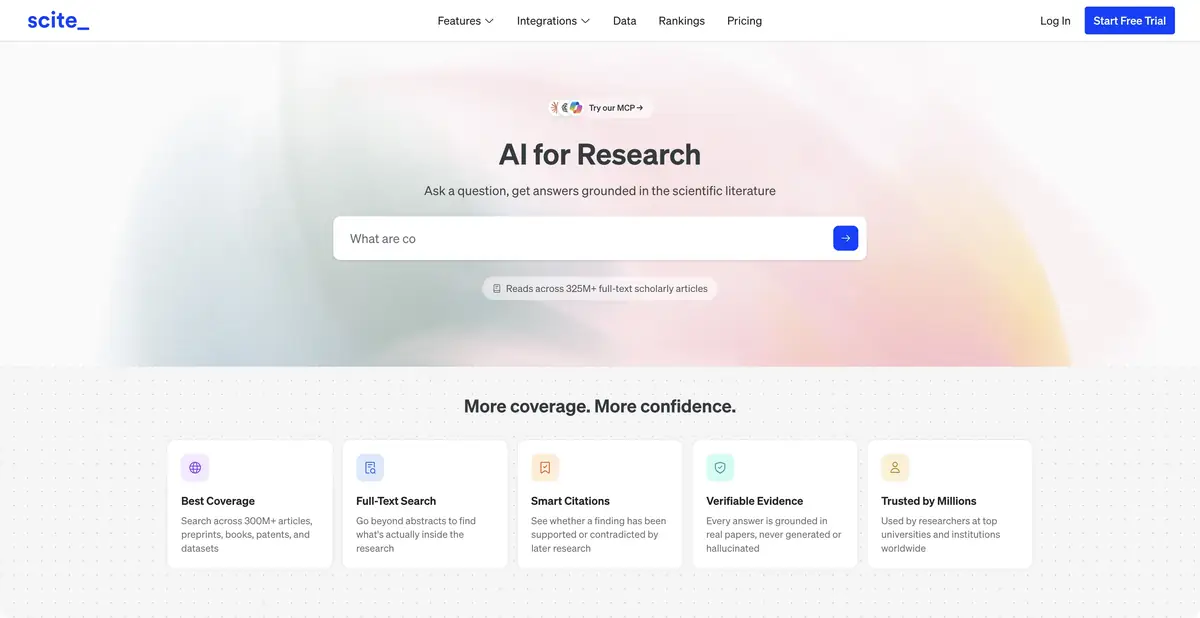
Check what is behind the frequently cited article
A high citation count does not itself mean a paper's conclusion is supported. Other papers may cite it as an example of a disputed method, use only its dataset or discuss an opposing result. scite helps reveal these differences through citation context and Smart Citations classifications.
This is a standalone research service. It is useful when you have already found a reference and want to understand how the idea developed: which arguments appeared later and how accurately the author of a forthcoming article represents the original paper.
Search, Assistant and Collections
The research Assistant answers questions using publications, while search finds material and context in scientific literature. Collections help organize selections and track related papers. Access to full texts and datasets depends on service coverage and agreements with rights holders.
Smart Citations distinguish between supporting, contrasting, and mentioning context. This is a useful guide to reading, but not an automatic reliability decision. One reference does not equal independent replication, and the absence of a classified objection does not prove that there is no objection.
Working Example: Check the argument in the review
Suppose a draft claims that a particular feedback format improves learning. Find the article the author cites and review later citations. Separately list studies that support the original conclusion, qualify it using a different sample or merely mention it in a review.
Then return to the texts themselves. Compare what the researchers measured: a final test, long-term retention or satisfaction with learning. This check helps replace an overly broad phrase with a precise statement under clear conditions.
Use in familiar tools
scite offers browser extension, integration with Zotero, MCP and software API. They allow you to access research data from other processes, but the presence of a tool in the interface does not mean the same rights for all team members. The plan and permissions of the account must be checked separately.
For a joint review, agree in advance what to keep: the original question, a specific quote, the type of context and your own assessment. Then the table will remain useful to a person who was not present during the search. Do not transfer only the classifier label to the final text without explanation.
Plans and restrictions
Core access requires a subscription; the official page describes a trial, individual plans and organizational plans. Programmatic features and usage allowances vary. Check trial-end and automatic-billing terms before activating trial access.
scite helps with discovery and checking arguments, but does not replace peer review. Incomplete source coverage, classification errors and ambiguous wording require careful reading. Scientific consensus cannot be inferred solely from colors and citation counts.
Suitable tasks
- Check out how more recent work discusses the scientific conclusion
- Find studies and citation contexts
- Gather arguments for a literature review
- Connect scientific data via API or MCP
Strengths
- Citation context instead of a citation count alone
- Assistant responses are related to publications
- Collections and tracking research
- Integrations with Zotero, browser and software tools
Limitations
- Citation classification can be wrong
- Coverage and full text are not available for every publication
- Supporting citation does not equal independent verification of the result
- API and additional data depend on the plan
Selection and conditions
- Free access
- Not confirmed
- Trial period
- Yes
- No sign-up required
- Not confirmed
- Russian interface
- Not confirmed
- Local installation
- Not confirmed
- API
- Yes
“Not confirmed” means there is not enough information. The feature may still be available; check the developer’s terms.
- Input formats
- Text
- Result
- Text
Terms
Primary access by subscription; there is a trial with renewal terms. The API and additional datasets depend on the plan.From task to first result
Practical example
- Task
- Check out how more recent work discusses the scientific conclusion
- What to prepare
- Research question: which interventions have been studied to improve sleep in adult shift workers?
Task brief or prompt
Which interventions to improve sleep have been studied in adult shift workers? Find relevant research papers; distinguish the type of intervention, study design, sample and measured outcomes. Do not make medical recommendations based on a single paper.
Expected result
A list of research papers and details of their study designs, for the researcher to verify against the full texts.
How to check the result
- Check the research question, sample and outcomes in each primary paper.
- Distinguish reviews, observational studies and experiments; do not turn an analysis into a treatment recommendation.
An editorial teaching example of a task brief, not the result of hands-on testing of the service. Check that the required mode is available, that you have rights to the source material and that the intended use of the result is permitted.
Check details
Official sources
This description is based on the developer’s material. Features, prices and availability may change; check the primary source before use.


