

Consensus combines scientific literature search with analysis of the papers found. It helps gather sources for a question, clarify methods and findings, and return to the publication an answer relies on.
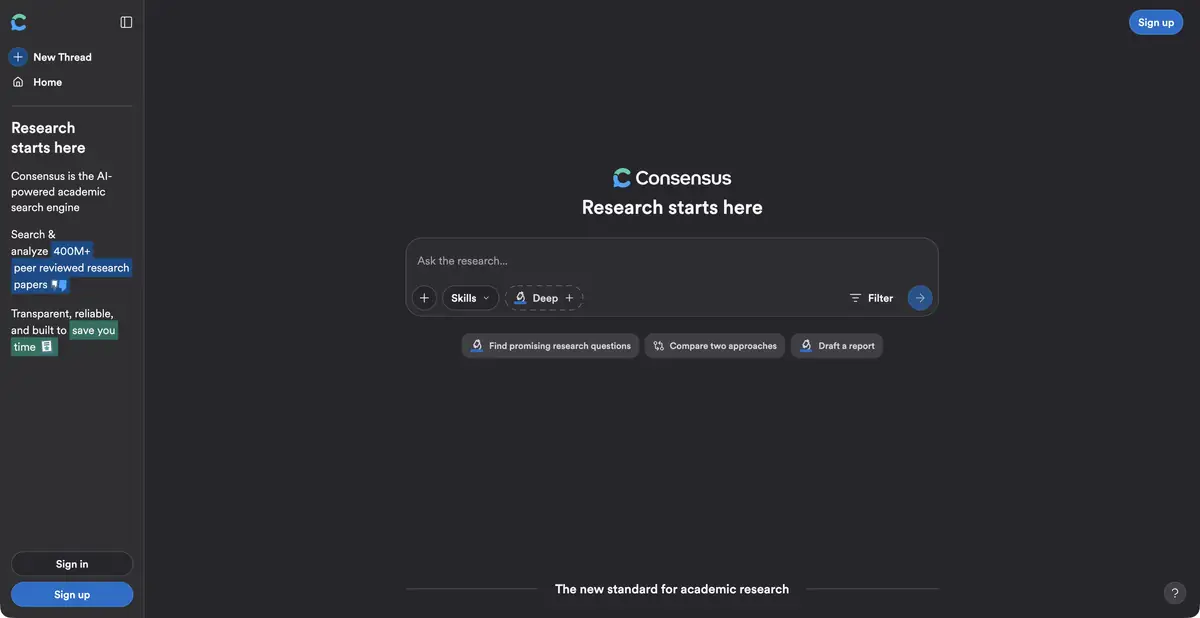
Start with a question rather than a predetermined conclusion
“Does a short walk help restore attention after work?” This is more useful than asking for proof of the benefits of walking. Consensus searches for scientific publications by meaning and keywords, and then links the answer to the found works. The service is designed for literature research, not for a normal conversation on any topic.
It will be useful to an editor, teacher or researcher who needs to quickly understand the subject area. But a convenient summary does not cancel the reading of sources: similar words in the title do not mean that the authors studied the right group of people or measured the same result.
What the discovered papers can tell you
Consensus has the usual search for publications, Pro answers, more extensive reviews and follow-up questions in Threads. Study Snapshot helps to highlight the characteristics of a separate study. For suitable questions, Consensus Meter shows the distribution of results in the literature found; it cannot be perceived as a vote of all scientists in the world.
Filters help narrow the set of papers by study criteria. In an answer, distinguish the abstract from the available full text: the amount of material read affects which limitations can be identified. Embedded links let you trace a short conclusion back to a specific source.
Example: check a claim for an educational article
Ask a question about adult participants, a short walk and attention measurement. Review the results: exclude material focused only on physical endurance, and distinguish laboratory from field studies. Request a comparison with fields for "participants," "conditions," "measurement" and "limitations."
Before publishing, open a few key papers, check the direction of the effect and do not turn a cautious result into a universal recommendation. If the data diverges, it is this discrepancy that should be explained to the reader.
Carry results into further work
Publications can be saved to a library, while answers and bibliographies can be transferred to other tools through available export methods. Official APIs and MCP let you integrate search and research sessions into your own workflow; their quotas are tied to the account plan.
When automating, determine in advance which fields are needed at the output. A link to an article and a note about the type of research is usually more useful than a long text without verifiable origin. Keep the search question together with the selection so that later it is clear why a particular work got into it.
Access and usage limits
There is a free level with limited use of advanced features and paid plans with other quotas. The number of available operations, API conditions and review parameters should be viewed in the current account and official help. Having a free plan does not guarantee the availability of payment or service in any country.
Consensus helps you navigate research, but does not replace a systematic selection method and expert assessment. A citation may be genuine while the conclusion drawn from it is too broad. Check medical, legal and financial interpretations particularly carefully.
Suitable tasks
- Find scientific papers on a narrow research question
- Compare methods and results across several publications
- Prepare a review with verifiable links
- Embed scientific search into your own process via API
Strengths
- Search and answers linked to scientific sources
- Subsequent questions retain the context of the study
- Individual study characteristics and filters are available
- API and MCP are documented
Limitations
- A discovered paper may lack accessible full text
- The review depends on the search question and the composition of sources
- Links and interpretations need to be checked manually
- Advanced analysis uses plan quotas
Selection and conditions
- Free access
- Yes
- Trial period
- Not confirmed
- No sign-up required
- Not confirmed
- Russian interface
- Not confirmed
- Local installation
- Not confirmed
- API
- Yes
“Not confirmed” means there is not enough information. The feature may still be available; check the developer’s terms.
- Input formats
- Text, Document
- Result
- Text
Terms
The free level limits advanced analysis; API/MCP and advanced reviews use account quotas.From task to first result
Practical example
- Task
- Find scientific papers on a narrow research question
- What to prepare
- Research question: which interventions have been studied to improve sleep in adult shift workers?
Task brief or prompt
Which interventions to improve sleep have been studied in adult shift workers? Find relevant research papers; distinguish the type of intervention, study design, sample and measured outcomes. Do not make medical recommendations based on a single paper.
Expected result
A list of research papers and details of their study designs, for the researcher to verify against the full texts.
How to check the result
- Check the research question, sample and outcomes in each primary paper.
- Distinguish reviews, observational studies and experiments; do not turn an analysis into a treatment recommendation.
An editorial teaching example of a task brief, not the result of hands-on testing of the service. Check that the required mode is available, that you have rights to the source material and that the intended use of the result is permitted.
Check details
Official sources
- Consensus features and search specifics
- Consensus plans and quotas
- Official Consensus API
- How Pro answers and source references work
This description is based on the developer’s material. Features, prices and availability may change; check the primary source before use.


