

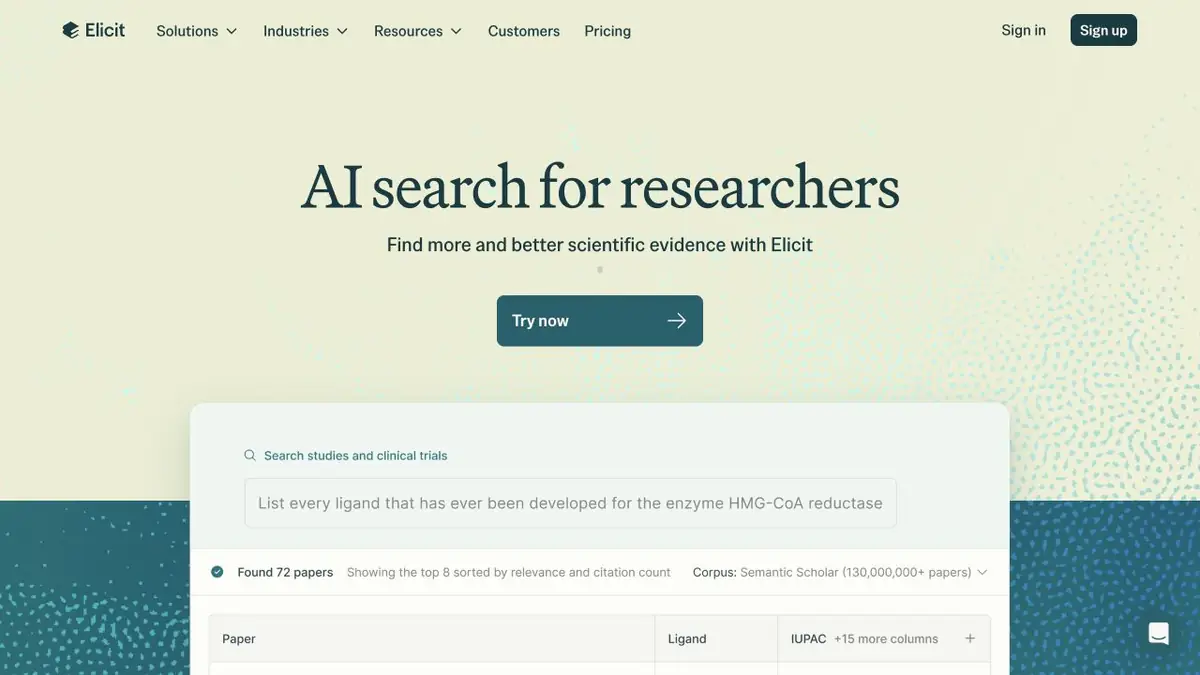
Elicit helps you find scientific papers and turn them into a verifiable table or review. It connects search and data extraction with links to source passages, leaving the researcher in control of the conclusions.
A research question instead of a long row of tabs
Once dozens of papers have accumulated on a topic, it is hard to keep track of whom the authors studied, what they compared and what they found. Elicit brings this work into one research process: it finds papers, helps select relevant ones and transfers the information you need into a table. The product is developed by the independent company Elicit, Inc.
You can start with a question in everyday language. Semantic search looks for papers by the meaning of the query, so the terms do not have to match exactly. The next priority is the source set itself: check that the convenient summary rests on studies of the right type, period and subject.
Research Agent, a quick report or a systematic review
The current Elicit offers three main ways to work. Research Agent lets you search, discuss uploaded materials and refine the result in a single session. It creates reports, tables and other research materials. It can draw on scientific papers, web sources and your attachments; check individual answers against the links provided.
Research Report is suited to an initial overview of a question with references. A separate Systematic Review workflow supports structured screening: you define sources and criteria, screen the papers and extract data from those included. This mode is available on Pro and higher plans. It helps you conduct a review, but does not make methodological decisions for the researcher.
Example: comparing studies of distance learning
Suppose an editorial team needs to examine how feedback formats affect adult online learning. Narrow the question first: focus on adult learners, distance courses and a comparison of particular forms of feedback. Outcomes might include course completion and measurable learning achievement. This avoids indiscriminately combining school lessons, in-person lectures and reviews of a platform’s design.
Define the table fields in advance: participants, study design, comparison conditions, duration, measured outcome and limitations. In Systematic Review, you can configure extraction columns and open a cell to see supporting quotations. Test the definitions on a few papers before processing the whole set. Leave a missing value unknown rather than replacing it with a guess.
This is an example of a research brief, not an experiment we conducted. Compare the final table with the full texts and separately consider whether the studies are comparable in the first place.
Save the result and continue working
Reports can be exported as PDF or Word files. Tables support CSV and Excel; suitable lists of sources support RIS and BIB. The conditions differ: exporting Research Agent tables requires Plus or above, while Systematic Review tables require Pro or above. Before choosing a plan, check the particular format and workflow you need.
Elicit has an official API for search, research sessions and library management; the documentation also describes MCP. Programmatic access requires an eligible account on Pro or a higher plan. This is a separate route for automation, involving configuration of keys, quotas and error handling.
Where manual checking matters
A quotation makes checking easier, but does not prove a conclusion by itself. Open the source passage: a number might refer to a different group, unit or follow-up period. Distinguish the paper authors’ claim, the extracted value and your own interpretation.
Not every paper found has its full text available: some publications are represented only by an abstract. Check what material supports a cell or conclusion. In Systematic Review, you can add a full text manually; upload it only if you have the necessary rights. An abstract may be insufficient for checking methods, individual results and the authors’ caveats.
Elicit is primarily designed for English-language literature. Queries and answers in other languages are possible in some workflows, but quality varies considerably and usage consumption may be higher. The service is not intended for translation or document reproduction. For a Russian-language review, check the meaning of technical terms and base your conclusions on the original studies.
Free plan and paid features
An account is required. The free Basic plan includes limited agent and report usage; higher plans expand usage, exports, systematic reviews and team features. Academic and industry terms differ. No exact prices are fixed here: before subscribing, compare the features you need, the allowance and additional-usage rules on the official page.
Do not upload confidential research or personal data without permission. Check service availability, payment options and material-processing terms for your organisation and region; a free plan does not mean access from every country.
Suitable tasks
- Find scientific papers for a specific research question
- Compare the methods, participants and results of several studies
- Prepare a literature review with verifiable sources
- Configure screening and data extraction for a systematic review
- Take the table and references into the next stage of work
Strengths
- Search by the meaning of a research question
- Links between extracted values and supporting passages
- A dedicated screening workflow for systematic reviews
- Export reports, tables and references in working formats
- Official API and MCP for research automation
Limitations
- Extracted data and conclusions must be checked against the papers
- Some papers found have only an abstract available; full-text access is not guaranteed
- The main language specialisation is English
- Systematic reviews, table exports and API access depend on the plan
- Usage is consumed under the selected workflow’s terms; additional operations may require payment
- A review does not replace assessment of study quality or methodological decisions
Check details
Official sources
- Official Elicit product
- Choosing a workflow in Elicit
- Systematic reviews: from screening to data extraction
- Elicit language limitations
- Exporting tables, reports and references
- Plans and terms of use
- Official Elicit API
This description is based on the developer’s material. Features, prices and availability may change; check the primary source before use.


