
OpenHands lets you run and embed agents that work with code and tools. Open components suit your own deployment, while managed options reduce the work involved in environments and maintenance.
Separate interface and execution
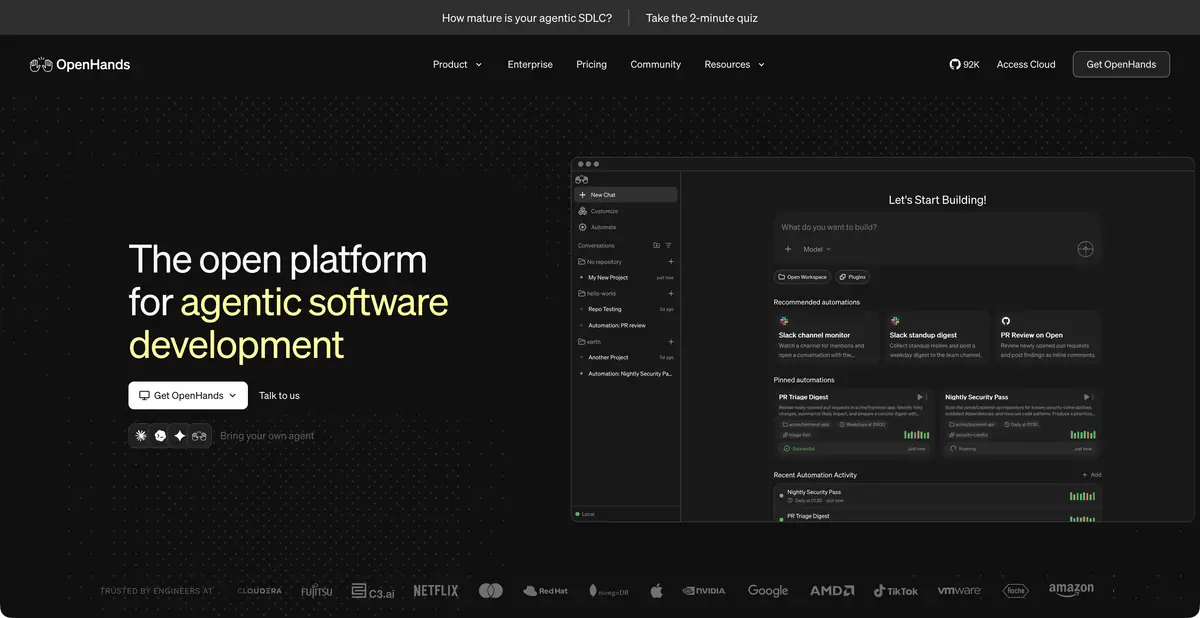
In the current architecture, OpenHands Agent Canvas is a browser-based hub for sessions and automations. It connects to one or more backend servers. You can run the stack alongside your project or use your own, cloud, or enterprise backend. The interface’s appearance therefore does not establish where commands execute.
This distinction matters for teams managing environments and access. Repository working copies, agent tools, model providers, and result storage must be defined separately. One accessible web interface does not mean the entire production environment is ready.
SDK and agent server
The official Software Agent SDK is a Python library for building agents. Agent Server exposes sessions, tools, and workspaces through REST and WebSocket. This provides programmatic access to the platform itself, rather than only an external model. MCP and plugins serve a different purpose by connecting extra capabilities.
Before building complex automation, reproduce a small official example and confirm that you can stop it, retrieve its state, and save its result. For recurring tasks, distinguish successful agent completion, a completed check, and an external action: these are three different events with separate failure modes.
Example: update the dependency in a separate copy
Suppose a project needs a library update without changing its public interface. Prepare an isolated environment and specify the allowed dependency and verification commands. Ask the agent to investigate incompatibilities, update necessary files, and describe what needed adaptation.
After execution, check the lockfile, new transitive dependencies, and test results. If the environment prevented tests from running, retain that as an explicit report limitation. A successful package installation does not prove app compatibility. The exercise should produce a verifiable diff, rather than an unreviewed automatic deployment.
Open-source components and actual costs
Agent Canvas is officially free to self-host and uses model access you provide. Team features, user management, and enterprise options have separate plans. Free source code does not cover cloud tokens or the machines that run tasks.
Self-hosting gives control over infrastructure, but the model may remain external. A fully local AI workflow must be verified for the selected model, tools, and network connections. Installing Canvas alone therefore does not establish that all processing is local. Before connecting a private repository, check component licenses, server permissions, and the chosen provider’s data processing rules.
With multiple servers, explicitly map each session to its workspace. Otherwise, a correct command may run in the wrong project copy. Check more than the SDK response: verify the final file’s location, the current branch, and artifact access for the reviewer.
Suitable tasks
- Build your own agent development environment
- Run verifiable tasks in an isolated environment
- Embed agent via Python SDK and server API
- Manage sessions through Agent Canvas
Strengths
- Separate interface, server and SDK
- Open-source, self-hosted Canvas
- The product’s own REST and WebSocket interfaces
Limitations
- Maintenance of the environment remains a separate task
- Models and compute do not become free with the code
- Self-hosted interface does not prove local inference
Selection and conditions
- Free access
- Yes
- Trial period
- Yes
- No sign-up required
- Not confirmed
- Russian interface
- Not confirmed
- Local installation
- Not confirmed
- API
- Yes
“Not confirmed” means there is not enough information. The feature may still be available; check the developer’s terms.
- Input formats
- Text, Code
- Result
- Text, Code
Terms
The open-source Canvas/self-hosted stack is free under its component licenses; BYOK and infrastructure costs are separate. The trial applies to the team offering. REST/WebSocket Agent Server is confirmed; on-device model processing has not been established for every deployment.From task to first result
Practical example
- Task
- Build your own agent development environment
- What to prepare
- A small part of your own project and a reproducible description of the error, with no tokens or passwords.
Task brief or prompt
Explain why this function handles an empty list incorrectly. First describe its current behavior, then suggest a minimal fix and checks for empty, normal and invalid input. Do not change other parts of the project unnecessarily.
Expected result
An explanation of the cause, a small proposed diff and checks to run locally.
How to check the result
- Read the diff before applying it.
- Run the checks in a separate working copy and make sure no secrets were included in the prompt.
An editorial teaching example of a task brief, not the result of hands-on testing of the service. Check that the required mode is available, that you have rights to the source material and that the intended use of the result is permitted.
Check details
Official sources
- OpenHands: an open agent platform
- OpenHands: Canvas, Agent Server, SDK and Cloud
- OpenHands: self-hosting and team plans
- OpenHands: the official open repository
This description is based on the developer’s material. Features, prices and availability may change; check the primary source before use.