

Llama consists of Meta models that developers can host in their own infrastructure under the license terms. It is a separate family for building applications, not another name for the Meta AI chat.
Model as the basis of your application
Choose Llama when control over an AI feature's hosting and behavior matters. Developers can obtain suitable weights, configure request processing and embed the model in their own system. A ready-made chat, document search and access management do not appear automatically: they must be built around the model.
Before choosing, define the task and constraints. Brief request classification and complex conversations about long documents may need different configurations. A larger model will not necessarily be more practical if it cannot be hosted on the available infrastructure.
Options vary in capabilities
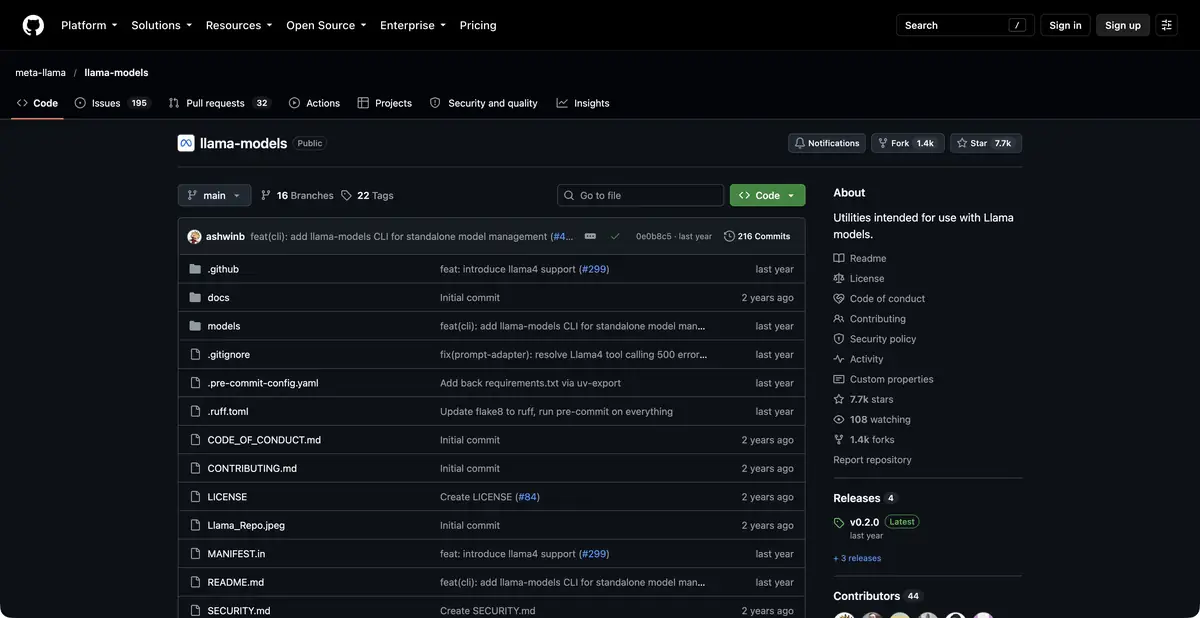
The official repository lists generations, licenses and instructions. The family has text and multimodal options, including models with image processing. The set of input data depends on the specific release: the presence of a visual mode in one model is not transferred to all others.
Distinguish a base model from an instruction-tuned model. Base weights require further preparation for the expected user-facing behavior. For ordinary conversation, check the recommended message format and model type in the official model card.
Example: an assistant for internal instructions
A team can build an answering system using its own policy base. First retrieve relevant passages, then give the model only the selected excerpts and question. Require references to internal documents and allow an honest "insufficient information" response.
Test tasks with conflicting and missing information. If a rule is not found, the system must not present a guess as a company directive. This is an architecture and testing example, not a claim about a ready-made feature in any downloaded checkpoint or a test we performed.
Using your own hardware still involves costs
The official instructions describe running on a GPU and reduced-precision options. Requirements can vary significantly; a long context uses additional memory. Before deployment, assess not only loading the weights but also concurrent requests, storage, updates and monitoring.
Local hosting lets you build a controlled processing environment. It does not guarantee privacy by itself: check logs, the app's external connections, user permissions and document-upload paths. Secrets must not appear in publicly accessible diagnostic logs.
License and result verification
The Llama open weights are distributed according to their license terms and conditions of use. Read the documents of the selected generation, including distribution requirements and acceptable scenarios. The availability of downloads is not equal to the absence of any restrictions.
Check your own application
The model can make mistakes, reproduce data biases and confidently fill gaps in information. Test your application's quality on its actual tasks; measurements published by the developer do not replace that testing.
Suitable tasks
- Build your own text AI service
- Build answers from verifiable document passages
- Run a suitable model in your infrastructure
- Compare configurations for code and multimodal input
Strengths
- Available official weights and instructions
- Choice of models for different tasks and infrastructure
- Control over hosting and integration
Limitations
- Requires technical team and computing resources
- Features depend on the specific generation
- There are license and operating conditions
Selection and conditions
- Free access
- Yes
- Trial period
- Not confirmed
- No sign-up required
- Not confirmed
- Russian interface
- Not confirmed
- Local installation
- Yes
- API
- Not confirmed
“Not confirmed” means there is not enough information. The feature may still be available; check the developer’s terms.
- Input formats
- Text, Code, Image
- Result
- Text, Code
Terms
Licensed open weights and self-hosting; specifications depend on the release. A ready-made external API and user interface are not assumed for the entire family.From task to first result
Practical example
- Task
- Build your own text AI service
- What to prepare
- A small part of your own project and a reproducible description of the error, with no tokens or passwords.
Task brief or prompt
Explain why this function handles an empty list incorrectly. First describe its current behavior, then suggest a minimal fix and checks for empty, normal and invalid input. Do not change other parts of the project unnecessarily.
Expected result
An explanation of the cause, a small proposed diff and checks to run locally.
How to check the result
- Read the diff before applying it.
- Run the checks in a separate working copy and make sure no secrets were included in the prompt.
An editorial teaching example of a task brief, not the result of hands-on testing of the service. Check that the required mode is available, that you have rights to the source material and that the intended use of the result is permitted.
Check details
Official sources
This description is based on the developer’s material. Features, prices and availability may change; check the primary source before use.


