

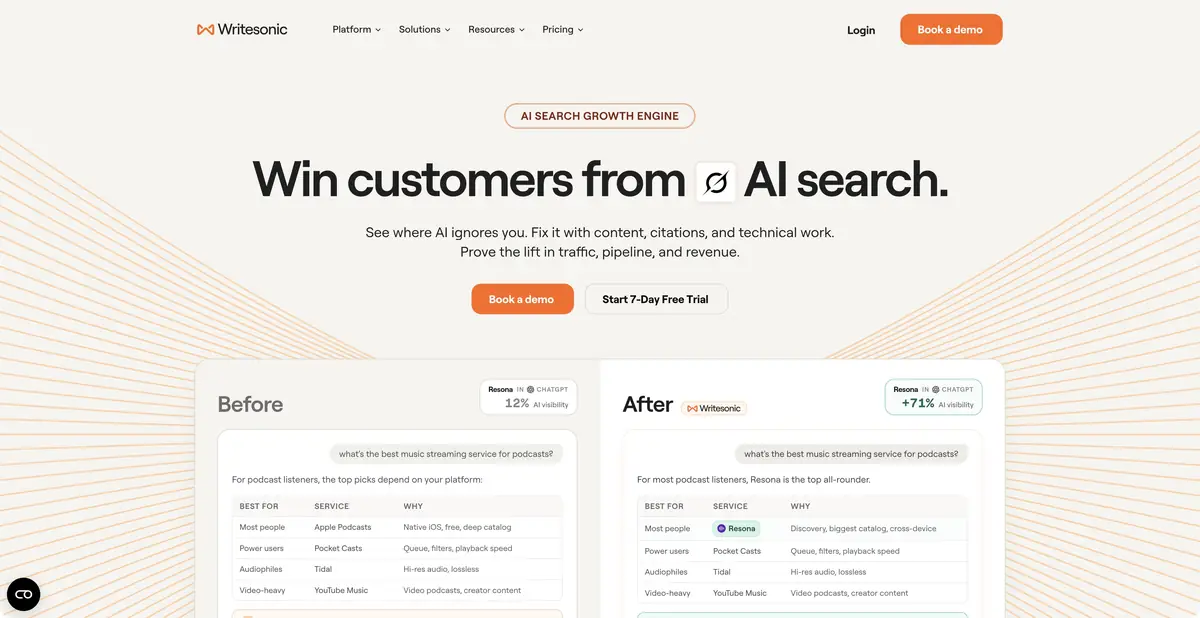
Writesonic combines content preparation with SEO/GEO tools. It helps track answers from AI platforms, find content gaps and organize work on pages.
Understand where there is a lack of useful material
The current Writesonic is focused on brand visibility in both conventional and AI search. Together with the preparation of the text, the platform offers tracking of answers, mentions and sources. These observations help to formulate the task, but do not prove a causal link between one page edit and the appearance of the brand in the answer.
Start with specific audience questions. If the project sells luminaires, it is more useful to study requests for light selection and conditions of use than simply repeating the company name. The list of questions should be related to the real need of the visitor.
SEO, GEO and content creation
Official materials describe AI article creation, technical website analysis and AI Search Visibility tools. A GEO project specifies a website, scope of analysis and target market. AI platform coverage and depth of analysis vary by plan.
The draft article should be built on your own knowledge about the product and verifiable sources. Automatically proposed topic is not proof of demand, and the characteristics mentioned by the competitor should not appear in your text as a property of your product.
Example: improve the page with buyers' questions
Suppose visitors ask if the lamp is suitable for reading. Gather real-world specifications, terms of use and typical support questions. On their basis, prepare a clear block of answers, separately noting what is not confirmed by documentation.
After editing, check that the page actually answers the person’s question. A set of keywords and a repeat of the brand are no substitute for explanations.
What the monitoring results mean
AI-system answers vary by query, market and time of checking. A monitored collection is therefore a sample of observations. A metric change is worth investigating but does not guarantee the same behavior for every user and wording.
Look at specific answers and sources, as well as the aggregate number. Check that the brand is identified correctly and companies with the same name have not been confused. When a conclusion matters for the budget, compare it with traffic analytics and your own pages' results.
Plans, API and cautious implementation
The website offers trial access and paid plans. Article, project, audit and monitoring quotas are counted separately; features depend on the tier. The developer documentation describes an API whose terms should be checked for the intended integration.
Do not automate unverified article publication just to increase volume. Establish fact-checking, editing and technical review first. Writesonic helps organize the process but does not promise search rankings, consistent AI-system recommendations or commercial results.
Suitable tasks
- Prepare an article from verified source information
- Examine brand mentions in a given sample of AI responses
- Find questions the website does not address
- Organize an SEO/GEO workflow and supported API integration
Strengths
- Content and SEO/GEO in one work environment
- Documented monitoring scope and market settings
- Plans set separate allowances for different operations
Limitations
- Monitoring reflects a sample of requests, not the entire AI search
- Texts and found sources require editorial review
- No guarantee of higher rankings, mentions or sales
Selection and conditions
- Free access
- Not confirmed
- Trial period
- Yes
- No sign-up required
- Not confirmed
- Russian interface
- Not confirmed
- Local installation
- Not confirmed
- API
- Yes
“Not confirmed” means there is not enough information. The feature may still be available; check the developer’s terms.
- Input formats
- Text, Document
- Result
- Text
Terms
Trial access and paid quotas for content, audits and AI monitoring. The results of the monitoring refer to the selected queries and market, and do not guarantee the coverage of the entire search.From task to first result
Practical example
- Task
- Prepare an article from verified source information
- What to prepare
- Short brief: the workshop makes a table lamp; its material, dimensions and delivery terms are confirmed.
Task brief or prompt
Task: prepare an email and a short lamp description from the attached brief. Preserve facts, explain benefits without superlatives and separately flag missing information. Apply the approved brand tone.
Expected result
Two consistent drafts for different channels, with verifiable specifications and no invented promises.
How to check the result
- Compare each feature with the brief.
- Check differences in tone, length and calls to action for each channel.
An editorial teaching example of a task brief, not the result of hands-on testing of the service. Check that the required mode is available, that you have rights to the source material and that the intended use of the result is permitted.
Check details
Official sources
This description is based on the developer’s material. Features, prices and availability may change; check the primary source before use.

