

Tavus creates an interactive AI conversation partner that responds in a video call. Unlike generating a conventional video, this requires attention to the dialogue, available knowledge, voice, and limits on agent actions.
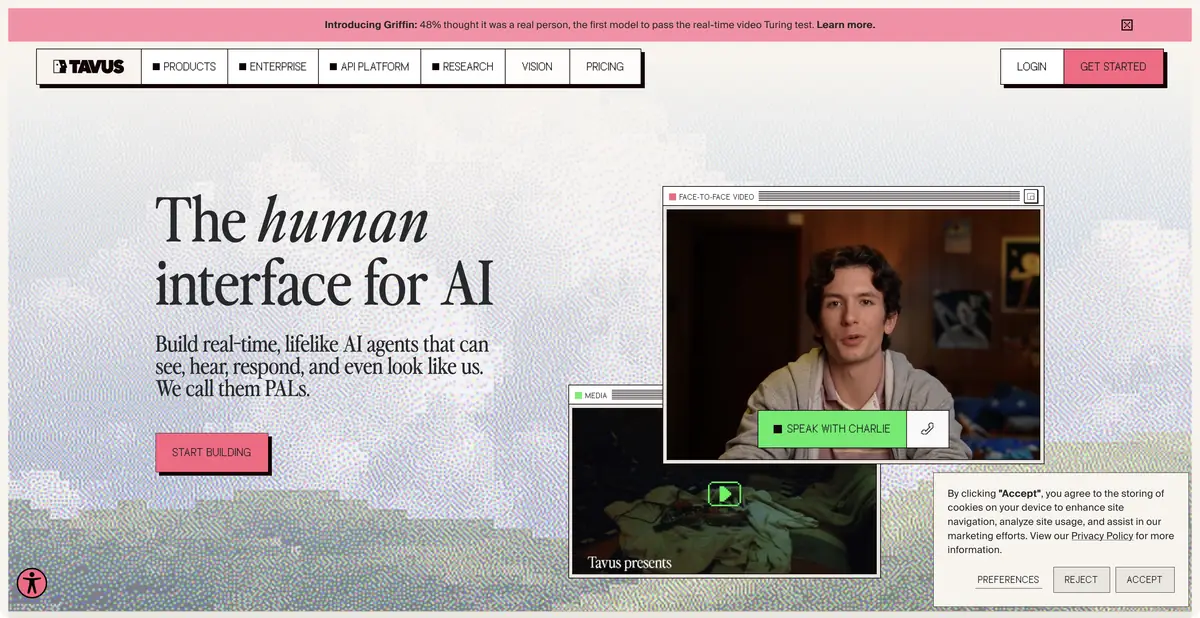
Video conversation instead of a pre-recorded video
Practicing a conversation requires more than generating a presenter reading fixed text. Tavus offers Conversational Video Interface, or CVI, for a video partner that responds to users in real time. A configured agent is now called PAL; Face defines its appearance and Voice its voice. Official documentation retains the older persona and replica names for API compatibility, so these do not represent separate new products. The main task is to connect clear behavior with a live video channel.
You need to adjust the behavior, not just the face
The documentation describes knowledge, goals, constraints, tools, and layers of the conversational workflow. You can choose an authorized likeness and voice, then define the questions the agent should ask and the materials it should rely on. Connections to external tools require separate oversight: a pleasant conversational manner does not prove an action in another system is correct.
The interface should clearly tell users that they are interacting with AI. Using a real person’s portrait and voice requires the necessary permissions. The conversation partner may misunderstand an utterance, interrupt someone, or respond too confidently despite insufficient data. Include these cases in preliminary testing.
Example: educational consultation about the library
For an internal educational prototype, prepare a short knowledge base about a fictional library: registration, renewal rules, and opening hours. Configure PAL to answer only from this information, ask for clarification when a branch is unknown, and honestly admit when no answer is available. Start with a ready-made Face you are authorized to use so dialogue testing does not depend on creating a custom digital twin.
Run several test conversations: an ordinary question, a correction from the user, a pause, and a request for information absent from the knowledge base. Compare answers with the knowledge base and assess turn-taking and synchronization. This scenario does not involve real patron data and is not a result of a Tavus test we conducted.
Quotas, API, and operation
The pricing page separates consumer PAL plans from developer access. Developers have a limited free basic tier, followed by subscriptions and usage-based billing. Video generation quotas and interactive conversation minutes are different quantities; keep them separate when estimating a project. The official API configures and starts conversations and other supported operations.
Before integration, check latency on the actual network, required language support, concurrent session limits, and behavior after disconnection. Conversation recording, storage, and connected sources need carefully designed access controls. A polished demonstration shows an interface concept; suitability for real users depends on checking the entire workflow.
For each test conversation, define the expected scope of the answer in advance. This helps distinguish a valid clarification from a confident answer unsupported by the knowledge base.
Suitable tasks
- Create an educational video conversation partner
- Test an interactive support workflow
- Embed a conversational video interface into the application
Strengths
- A proprietary conversational video platform
- Behavior, knowledge, voice, and likeness are configurable
- Official API and free developer tier
Limitations
- Check latency and interruptions
- Conversations and video generation have different quotas
- Permission to use a digital likeness is required
Selection and conditions
- Free access
- Yes
- Trial period
- Not confirmed
- No sign-up required
- Not confirmed
- Russian interface
- Not confirmed
- Local installation
- Not confirmed
- API
- Yes
“Not confirmed” means there is not enough information. The feature may still be available; check the developer’s terms.
- Input formats
- Text, Audio, Video
- Result
- Video, Audio, Text
Terms
The free developer plan has resource limits. PAL, conversation minutes, and video generation are metered separately; speech support does not establish the interface language.From task to first result
Practical example
- Task
- Create an educational video conversation partner
- What to prepare
- Verified rules for a fictional library, an authorized likeness and voice, and several test questions for a video conversation.
Task brief or prompt
Assignment: configure an interactive AI conversation partner to explain library rules. Answer only from the supplied information, ask for clarification when a branch is unknown, and acknowledge missing data. Test an ordinary utterance, a correction, a pause, and a question outside the knowledge base.
Expected result
An educational interactive video conversation with checked behavior; this configures a conversation partner rather than a fixed video with guaranteed answers.
How to check the result
- Compare answers with the knowledge base and retain uncertainty where information is unknown.
- Evaluate turn-taking, interruptions, synchronization, and behavior after a lost connection.
- Tell users the conversation partner is AI, and check consent for likeness, voice, and recording.
An editorial teaching example of a task brief, not the result of hands-on testing of the service. Check that the required mode is available, that you have rights to the source material and that the intended use of the result is permitted.
Check details
Official sources
This description is based on the developer’s material. Features, prices and availability may change; check the primary source before use.