

The current Resemble AI is focused on detecting synthetic media and authentication. Commercial voice products have been moved to the research archive; they cannot be passed off as the current paid TTS platform.
Check the file before further action
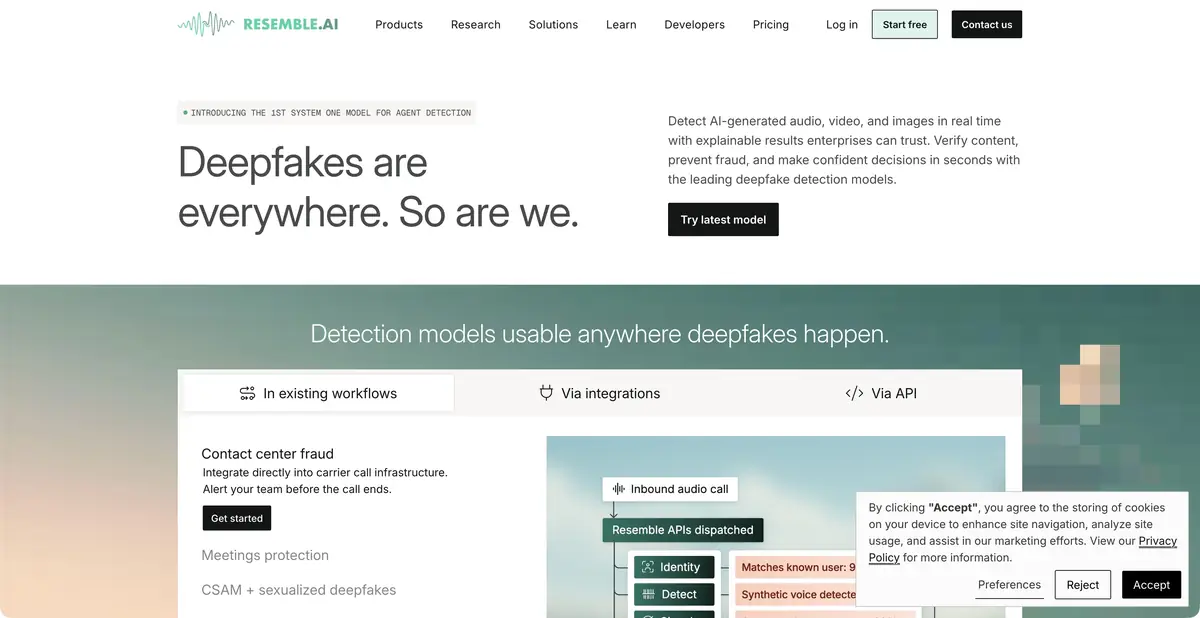
An unusual voice message may warrant checking, but a feeling alone is insufficient. Resemble AI accepts media and returns analysis of signs of generation or modification. The current platform works with audio, images, and video; its documentation describes detection, provenance information, identity matching, and watermarks. This content verification infrastructure can be integrated into editorial or enterprise workflows.
The brand has a history of voice generation and open Chatterbox research. Current help places these materials in the Voice AI Research archive and states that paid commercial voice products are no longer offered. Base a new project on the platform’s current purpose, rather than a feature in an old review.
Example: A suspicious message from the supplier
Suppose an employee receives a recording urgently requesting a change to payment details. For a practice check, use an authorized demonstration file and submit it for analysis. Save the source file, job ID, settings, and returned metrics. If the system flags suspicious segments, listen to them in the full context rather than judging an isolated word.
Define the next step in advance, such as confirming the request through an established communication channel. A low suspicion score does not verify the speaker’s identity, and a high score does not prove fraud. Recompression, recording processing, noise, and differences from training examples can affect analysis. A single report number must not automatically trigger a financial action.
What you can integrate through the API
Public documentation describes the service’s own endpoints for analysis, file uploads, reports, and identity checks. You can build a queue that accepts a file, retrieves a result, and sends disputed cases to a person. This requires error handling, a decision log, and a clear rule for incomplete or ambiguous responses.
Labeling and detection serve different purposes. A watermark’s presence or absence relates to a specific provenance mechanism; it does not make every third-party file trustworthy. Matching against a reference voice also requires rights to the reference and access controls. Do not upload personal materials out of curiosity: first establish the basis for processing and an authorized processing environment.
Access and meaning of results
The site offers a standalone account, programmatic access, and enterprise options. Billing depends on models and operations used; self-hosting terms are arranged separately. A free invitation on a page should not be read as a promise of unlimited analysis forever.
When choosing a service, consider response format, supported media types, and whether explanations can be saved. Evaluate it using authorized examples from your domain with known provenance. Even then, a detector remains a supporting signal: final conclusions rely on independent evidence, source files, and human judgment.
Suitable tasks
- Check suspicious audio file
- Add synthetic media analysis to a review queue
- Investigate the origin and labeling of content
- Refer a disputed result to a specialist
Strengths
- Audio, images and video in one verification process
- Separate operations for detection, provenance, and labeling
- The product’s own API with technical documentation
Limitations
- Detector indicators do not prove authenticity or deception
- Generative voice products belong to the research archive
- Access and payment depend on the model and operation
Selection and conditions
- Free access
- Not confirmed
- Trial period
- Not confirmed
- No sign-up required
- Not confirmed
- Russian interface
- Not confirmed
- Local installation
- Not confirmed
- API
- Yes
“Not confirmed” means there is not enough information. The feature may still be available; check the developer’s terms.
- Input formats
- Audio, Image, Video
- Result
- Data
Terms
This describes the current detection and provenance verification platform. Archived voice APIs are not attributed to the current commercial service; analysis results require independent confirmation.From task to first result
Practical example
- Task
- Check suspicious audio file
- What to prepare
- Your own demonstration audio file with known provenance and permission for analysis; retain the unchanged original.
Task brief or prompt
Assignment: submit a file to the current synthetic media analysis mode and save metrics with the job ID. Compare disputed segments with the original. Decide authenticity only with independent corroboration; do not treat a detector score as proof.
Expected result
Analysis data for further checking, such as a JSON API response; this is an educational example, rather than a detection result we obtained.
How to check the result
- Save the source file, settings, and full response; check which metrics the selected mode actually returned.
- Do not deduce the identity of the speaker or the fact of deception from one indicator; confirm the conclusion in an independent way.
An editorial teaching example of a task brief, not the result of hands-on testing of the service. Check that the required mode is available, that you have rights to the source material and that the intended use of the result is permitted.
Check details
Official sources
- Current Media Analysis Platform
- Current documentation and status of Voice AI Research
- Plans and payment model
This description is based on the developer’s material. Features, prices and availability may change; check the primary source before use.