

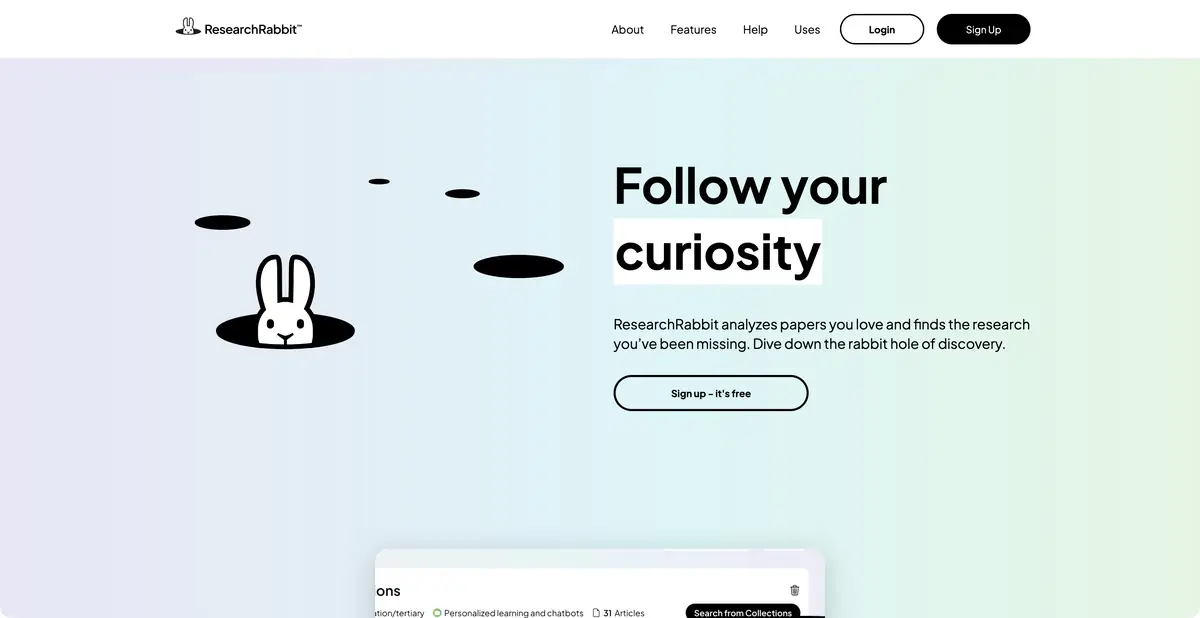
ResearchRabbit centers discovery on publications you have already found and their connections. It helps expand a collection, identify authors and research directions, and save a literature map for further work.
One good article as a starting point
ResearchRabbit is especially relevant at a time when several good works have already been found, but the overall picture has not yet developed. Instead of another long list of results, the service offers to explore the links between publications and gradually expand the collection. The initial set is important: it sets the direction of recommendations.
It is a tool for discovering scientific literature and organizing reading, not a generator of a finished thesis. It helps to see the neighboring branches of the topic, but does not decide for the researcher which works are suitable for a specific question and deserve inclusion in the review.
Collections, connections and further searches
Papers are gathered in a library and collections. As you explore the literature, recommendations take your interests and actions into account; the map helps find related materials and authors. Collections can be shared, making it convenient to discuss an initial reading list with colleagues.
This navigation supports iterative search: explore one branch, refine the question, add a new starting paper and examine the links again. However, staying within a familiar circle risks missing another school of thought or different terminology. Supplement the map with an independent keyword search.
Example: find a missing branch of the literature
To review adult learning, collect a few papers about distance courses. Then research separately related publications about feedback, self-regulation and evaluation of results. Keep directions separate so that one popular topic does not displace the others.
Record why a source was selected: a relevant method, shared sample, development of an idea or criticism of an approach. A new paper merely citing the original in a review paragraph does not directly confirm its conclusion.
How to read the map and choose a plan
An attractive network has a tempting side effect: nearby papers seem substantively similar. Yet a link may reflect citation, authorship or the algorithm's behavior. Before drawing conclusions about a research direction, read abstracts and available full texts.
Check bibliographic data before exporting to your own system. Verify the title, DOI and version: a preprint may differ from the final article. ResearchRabbit helps build a reading path, but does not grant access rights to closed texts or guarantee a complete review.
The official page describes a free plan with library, collections and basic search. ResearchRabbit+ adds advanced settings and features for larger collections; there are also organizational conditions. Specific limits change, so check them for the scope of your review.
A small meaningful collection is enough to start. First, make sure that the recommendations really help your question, and only then choose a paid level. Having a subscription extends the working tools, but doesn’t fix too broad a topic or randomly selected source articles.
Suitable tasks
- Expand a research reading list from known starting publications
- Find related topics, research and authors
- Organize literature into collections
- Discuss source map with colleagues
Strengths
- Visual connections between scientific papers
- Iterative search from source articles
- Library, collections and joint discussion
- There is a permanent free plan
Limitations
- Recommendations depend on the initial set of papers
- The map does not guarantee an exhaustive review
- Links between publications do not mean their conclusions agree
- Full text and access rights are checked separately
Selection and conditions
- Free access
- Yes
- Trial period
- Not confirmed
- No sign-up required
- Not confirmed
- Russian interface
- Not confirmed
- Local installation
- Not confirmed
- API
- Not confirmed
“Not confirmed” means there is not enough information. The feature may still be available; check the developer’s terms.
- Input formats
- Text
- Result
- Text
Terms
The free plan includes a library and basic search; advanced settings and larger collections depend on the level of access.From task to first result
Practical example
- Task
- Expand a research reading list from known starting publications
- What to prepare
- Several relevant scientific papers already found, with titles or DOIs.
Task brief or prompt
Task: gather the initial articles into one collection, explore recommended and related papers, then group the directions discovered by topic. Do not treat proximity on the map as evidence that results agree.
Expected result
A map of further reading routes and a selection of related publications that the researcher evaluates independently.
How to check the result
- Check that the original articles really fit the question.
- Compare the recommendations with an independent search, so as not to dwell on one group of works.
An editorial teaching example of a task brief, not the result of hands-on testing of the service. Check that the required mode is available, that you have rights to the source material and that the intended use of the result is permitted.
Check details
Official sources
This description is based on the developer’s material. Features, prices and availability may change; check the primary source before use.