

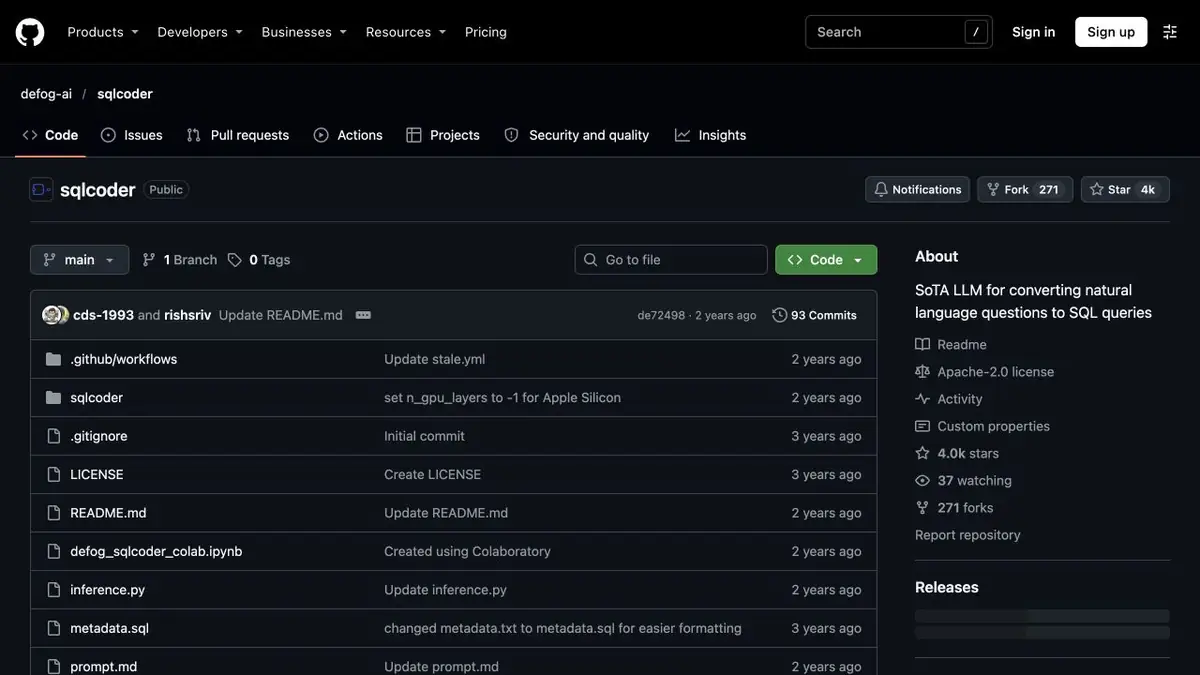
Defog’s SQLCoder specializes in generating SQL out of question and base schema. The model can be run in its environment, and the received request checked before execution.
What to transfer models instead of the entire base
SQLCoder generates a query for the question text and table schema. To prepare an example, the names of the fields, their types and the relationships between the tables are enough. Values from work lines are usually not needed. If the field is simply called status, explain what values the completed order means. Otherwise, the request may look correct and count the extra entries.
Fix the SQL dialect. Date interval recording and time processing functions differ between systems. The startup help shows the request format for a specific model, and you need to check the syntax in the target database.
Last purchase in the training set
Let the tables contain customers and orders. Ask about customers who last completed a purchase more than three months ago. Check that the filter for completed orders is valid until the last date. Check if customers are included without purchases. These are two different answers, and in the original question, the difference is easy to miss.
To verify, get a customer with one recent cancellation and an older completed purchase. The result shows what type of orders the maximum date belongs to.
Launching and controlling the result
The Defog pages describe launch options and the conditions for using weights. Check the requirements for the selected version. Prepared SQL can first be read and executed in a learning base with reading rights. A request that is executed without errors still needs to be checked with the conditions of the task.
Suitable tasks
- Draw up a draft query for the table description
- Check the query for the desired grouping and date range
Strengths
- You can run the model on your equipment
- The developer provides a sample schema and instructions for running the model
Limitations
- The model requires clear descriptions of fields and links
- Before completing the query, check the rights and the exact SQL dialect
Selection and conditions
- Free access
- Yes
- Trial period
- Not confirmed
- No sign-up required
- Not confirmed
- Russian interface
- Not confirmed
- Local installation
- Yes
- API
- Not confirmed
“Not confirmed” means there is not enough information. The feature may still be available; check the developer’s terms.
- Input formats
- Code, Text
- Result
- Code, Text
Terms
Code and weights are published. At its launch, the infrastructure is paid for, and the conditions of the placed services need to be checked separately. Before completing the query, check the rights and the exact SQL dialectFrom task to first result
Practical example
- Task
- Draw up a draft query for the table description
- What to prepare
- A chart of the tables, a list of statuses and the time of the last completed purchase.
Task brief or prompt
Prepare SELECT for customers who last completed a purchase more than three months ago. Refine customer processing without orders.
Expected result
A SQL draft that can be executed and checked on multiple lines.
How to check the result
- Check the grouping and filter area by status.
- Run the request with the right to read on the training set.
An editorial teaching example of a task brief, not the result of hands-on testing of the service. Check that the required mode is available, that you have rights to the source material and that the intended use of the result is permitted.
Check details
Official sources
This description is based on the developer’s material. Features, prices and availability may change; check the primary source before use.