

CodeRabbit integrates AI checks into the code change workflow. It helps you understand a diff, find potential bugs, and give developers specific findings, keeping the discussion alongside the change.
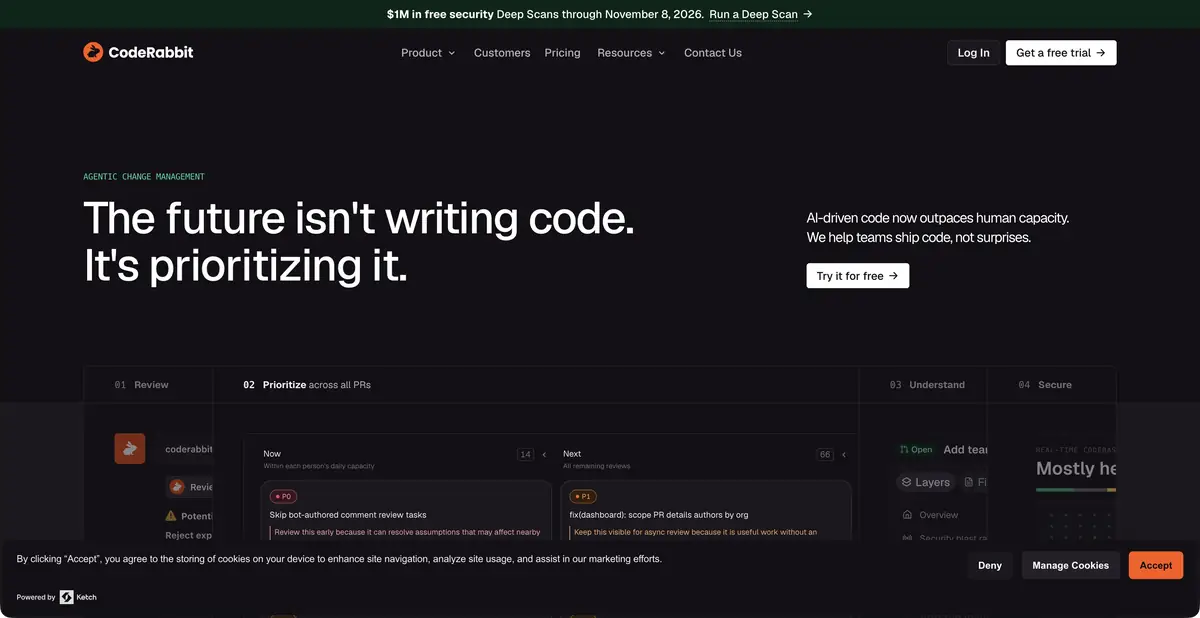
Review where the code is accepted
CodeRabbit analyzes changes and posts findings during pull request reviews. This suits teams that want an initial check before the main reviewer gets involved. Change explanations and code discussions help clarify the intent of an edit, while suggested fixes provide a starting point for discussion.
The current platform goes beyond a comment bot: official materials describe change controls, explanations, security, and agent actions. Availability depends on the plan and selected tool. Do not assume every basic review feature is available on every plan, or apply cloud agent terms to a standard pull request.
A finding must be reproducible
A meaningful finding identifies the condition in which code behaves incorrectly and explains its consequences. Separate a style suggestion from a defect. Team rules and task context help reduce comments that do not affect behavior.
For example, a pull request changes the order of access checks and file loading. Ask whether reading can now occur before authorization, and trace the request to the relevant object. The response should identify specific lines and a scenario a developer can verify. A general claim of increased risk is insufficient to block a change.
A workflow for accepting a fix
Suppose CodeRabbit suggests moving a check to the beginning of a handler. Before applying it, verify that early returns preserve the correct error codes and logging. Add checks for an unauthorized request and a normal authorized request. Only then consider accepting the proposed code.
If a finding is incorrect, reply with an explanation and a link to the relevant code. This is more useful than mechanically resolving every comment. The final review should assess the entire diff and task requirements: an automated assistant can miss an architectural issue or draw conclusions from incomplete context.
Pricing and programmatic capabilities
Free review of public repositories is officially available after installation through GitHub or GitLab. Private team projects have paid plans and usage policies; separate products and extra runs may have their own charges. Public repository terms do not automatically extend to private projects.
Enterprise separately lists an API, including review and MCP usage metrics. This is programmatic access restricted by plan; it should not be described as a free, general-purpose code generation API. Self-hosting also has separate enterprise terms. Running a CLI alongside source files does not prove that the model processes data locally.
An automated finding should not obscure standard CI check statuses. A reviewer may correctly identify a risk in a diff while the build fails for another reason. The team still needs to understand both signals and decide whether the change is ready.
Suitable tasks
- Get early pull request findings
- Explain and discuss diff
- Check changes in the public project
- Consider engineering rules when reviewing
Strengths
- Review and discussion next to the change
- Free use for public repositories
- Corporate metrics and API
Limitations
- False positives and missed findings are possible
- Plans limit feature sets and usage intensity
- API access and self-hosting have enterprise terms
Selection and conditions
- Free access
- Yes
- Trial period
- Not confirmed
- No sign-up required
- No
- Russian interface
- Not confirmed
- Local installation
- Not confirmed
- API
- Yes
“Not confirmed” means there is not enough information. The feature may still be available; check the developer’s terms.
- Input formats
- Text, Code
- Result
- Text, Code
Terms
Free use is confirmed for public repositories after connecting GitHub/GitLab. An API is listed for Enterprise, including metrics; this does not mean a free inference API.From task to first result
Practical example
- Task
- Get early pull request findings
- What to prepare
- A Pull request replaces a missing-value check with a truthiness check. The diff, function contract, and examples using 0, an empty string, and null are provided.
Task brief or prompt
Check the change against the original contract. Find cases where the new validation alters the meaning of valid input. For each finding, provide a diff fragment, a reproducible example, and its consequence. If the contract forbids an input, do not call its handling defective. Propose a minimal fix only for a confirmed problem.
Expected result
Pull request findings with specific failure conditions and proposed fixes; this is an educational task, rather than a completed review.
How to check the result
- Open the specified lines and related calls in the current version of the branch.
- Reproduce the finding with a test and distinguish a contract violation from a style preference.
An editorial teaching example of a task brief, not the result of hands-on testing of the service. Check that the required mode is available, that you have rights to the source material and that the intended use of the result is permitted.
Check details
Official sources
- CodeRabbit: change management and AI reviews
- CodeRabbit: official documentation
- CodeRabbit: OSS access, plans and Enterprise API
This description is based on the developer’s material. Features, prices and availability may change; check the primary source before use.